Marketing and Sales Automation for Irish Businesses: A Plain-English Guide
A plain-English guide to marketing and sales automation for Irish businesses: the highest-return automations, what they cost, and how to start.
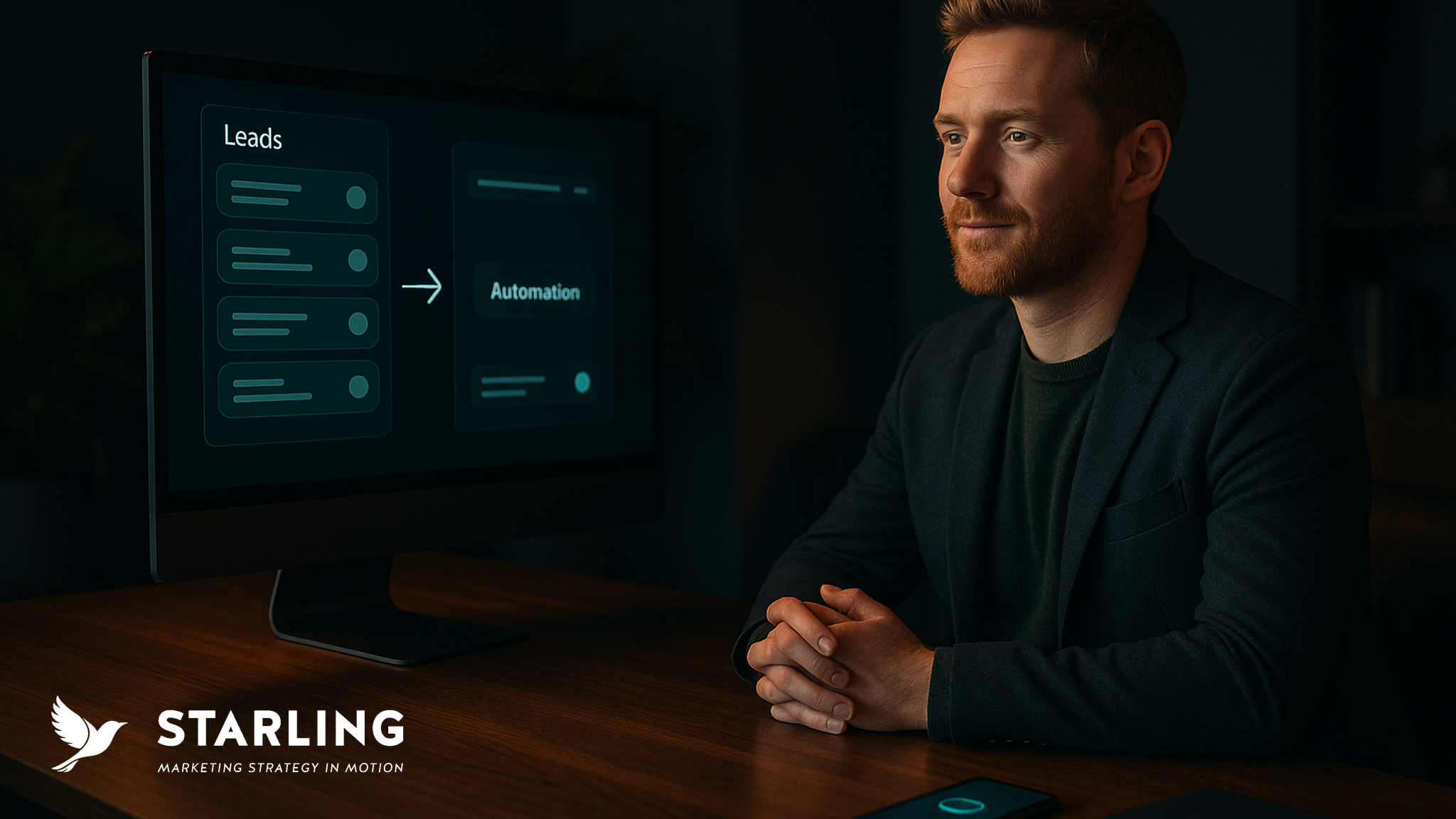
It is half six on a Thursday. You finally sit down, open your laptop, and there it is: an enquiry that came in at 9:14 that morning. Someone in Galway wanted a quote. They wanted it then, while the kettle was on and your name was the one they happened to be looking at. By the time you reply, they have rung two competitors, booked one, and forgotten you exist. The enquiry was never the problem. The nine-hour gap was.
That gap is where a frightening amount of Irish small-business revenue quietly leaks away. Not through bad marketing or a weak offer, but through the boring mechanics of follow-up: the email nobody saw, the lead that sat in an inbox, the spreadsheet that got copied wrong, the review request nobody ever sent. Marketing and sales automation is the unglamorous fix for all of it. Done well, it is the difference between a business that chases work and a business where the work chases itself.
This guide is written for the owner or manager of an Irish SME who suspects they are losing deals to admin, not to better rivals. No jargon dressed up as strategy. Just what automation actually is, where it pays off fastest, and how to start without setting your whole operation on fire.
Here is what this guide covers:
- What marketing and sales automation really means, in plain English
- The highest-return automations for a small Irish business
- How automation connects the tools you already pay for
- The current tool landscape, in generic terms
- What it costs and whether it is worth it
- A realistic plan for your first three automations
- How to choose an automation partner
- Answers to the questions owners actually ask
What Marketing and Sales Automation Actually Is
Strip away the marketing-speak and automation is simple: it is software doing the repetitive, time-sensitive jobs that a human keeps forgetting, getting wrong, or doing too slowly.
Think of every “I’ll do that later” task in your business. Send the new enquiry a reply. Add their details to a list. Remind them about their appointment. Ask the happy customer for a review. Nudge the quote that went quiet. Each one is small. Each one is forgettable. And each one, multiplied across a year, is the difference between a quiet month and a good one. Automation simply makes those tasks happen on their own, every time, in seconds, whether you are at your desk or up a ladder.
It Is Rules, Not Robots
The word “automation” makes people picture a server room doing something clever. The reality is closer to a very reliable junior staff member who never sleeps and never forgets. You set a rule once: “when someone fills in the contact form, send them this reply, add them to this list, and ping my phone.” From then on it just happens. The system follows the rule. You get on with your day.
This matters because the fear of automation is usually a fear of losing control. In practice it is the opposite. You decide exactly what happens and when. The machine only does the bit you told it to, precisely, forever.
Marketing Automation Versus Sales Automation
People use the terms interchangeably, but there is a useful line between them.
Marketing automation handles the many: email nurture sequences, audience segments, the welcome series that goes to everyone who downloads your guide. It is about staying in front of people at scale without writing each message by hand.
Sales automation handles the one: the individual deal moving through your pipeline. Routing a hot lead to the right person, reminding you to follow up on day three, flagging the quote that has gone cold. It is about making sure no single opportunity falls through the floor.
The two working together is where the money is. A lead gets nurtured by marketing, scored on how they behave, and handed to sales at the moment they are ready to buy. That hand-off, done automatically, is the bit most businesses miss.
None of this is about feeling modern. It is about not being the bottleneck in your own business.
The Automations With the Highest Return for a Small Irish Business
Not all automations are worth your time. A few of them pay for the whole exercise on their own. Start here.
Instant Lead Follow-Up
This is the one that matters most, and it is worth understanding why with hard numbers. In a Harvard Business Review audit of 2,241 US companies, firms that managed to make contact with a lead within an hour were nearly seven times more likely to qualify that lead than those who waited even sixty minutes longer. The average first response across those companies took 42 hours, and 23% never replied at all. The study is American, but the human behaviour is universal: people buy from whoever answers first, while their problem is still on fire.
Automation closes that gap to seconds. The moment an enquiry lands, the system fires off a warm, useful reply, drops the lead into your pipeline with the source attached, and alerts the right person by text. You have not won the deal. But you have stopped losing it before you have even seen it. For most Irish SMEs, this single automation is the highest-return thing on this entire list.
Email Nurture and Re-Engagement
Most enquiries are not ready to buy today. They are weighing it up, getting other quotes, waiting for payday. Without a system, those people simply vanish. With one, they get a sequence of genuinely helpful emails over the following weeks that keeps you in the frame until the timing is right.
The same logic rescues the dead. A win-back flow to customers who have not bought in a year, a gentle nudge to the quote that went silent, a seasonal reminder before the busy period. This is where a well-run email marketing programme stops being a monthly newsletter and starts being a quiet, automatic salesperson working your existing list.
Review and Referral Requests
Reviews are the single most undervalued asset of the average Irish SME. They drive local search, they reassure the next buyer, and almost nobody asks for them properly, because asking is awkward and easy to forget.
Automate it. The day after a job is finished or a purchase lands, the system sends a friendly request with a direct link. No awkward phone call, no “I must remember to ask”. Over a year, a business that asks every single happy customer ends up with a wall of reviews, while the one relying on memory ends up with three.
Booking, Reminders and No-Show Reduction
If your business runs on appointments, consultations, viewings, or service calls, this one pays for itself fast. Online booking that syncs to your calendar, an automatic confirmation, then a reminder the day before. No-shows drop. The phone-tag of rescheduling disappears. And every booking can quietly create a deal in your pipeline so nothing depends on you remembering to write it down.
Lead Scoring and Routing
As enquiries grow, “first come, first served” stops being fair to your best prospects. Scoring fixes that by tagging leads on behaviour and fit, so the hottest ones jump the queue and land with the right person automatically. The plumber gets the plumbing job. The high-value enquiry skips the general inbox. Nobody chases. The system decides.
Abandoned-Cart Recovery for Ecommerce
If you sell online, this is non-negotiable. A large share of shoppers fill a basket and leave: a phone rings, a child shouts, the bus arrives. An abandoned-cart flow sends a timely reminder, sometimes with a small nudge, and recovers a meaningful slice of sales that were already nine-tenths won. With Irish online retail still growing, and 35% of small Irish enterprises now selling over the internet according to the CSO, leaving that basket to rot is leaving money on the table.
The theme across every one of these: the work happens whether or not you remember to do it. That reliability is the entire point.
How Automation Connects the Tools You Already Use
Here is the part that surprises people. You almost certainly do not need new software. You need your existing software to talk to each other.
The typical Irish SME runs on a quiet sprawl of tools: a website form, an email platform, a calendar, an accounting or payment system, maybe an ad account or two, a spreadsheet holding it all together with hope. Each does its job in isolation. The lead from your ad form does not appear in your email list. The booking does not create an invoice. The payment does not update your records. So you become the integration: copying, pasting, re-keying, dropping things.
Automation removes you from that role. A lead from an ad form arrives in your central system with its source already attached, so you know what is working. A booking made online creates the deal automatically. A payment closes it without a single manual step. The information flows once, cleanly, instead of being carried by hand between five places.
The Central Hub Idea
Most automation setups orbit a central customer database, the place every lead, contact, and deal lives. Everything else plugs into it. Marketing feeds leads in, sales moves them along, and the owner finally gets one screen that answers the only questions that matter: where are my leads coming from, and what is happening to them?
This is precisely what a marketing and sales automation build is for: connecting the scattered tools you already pay for into one system that runs itself, with two-way sync so a change in one place updates everywhere. The goal is not more software. It is less double-entry, fewer dropped balls, and an honest answer to “is the marketing actually working”.
The Tool Landscape, in Plain Terms
You do not need to know the product names to make a good decision. You need to know the categories.
There are customer databases (often called CRMs) that hold your contacts and deals. There are email and marketing platforms that send and segment. There are connector tools whose whole job is wiring one app to another. There are scheduling and booking tools, payment tools, and form tools. Some platforms try to do several of these at once; others do one thing well and connect to the rest.
The right combination depends entirely on your business, your budget, and what you already use. A solo consultant and a twelve-person trades firm need very different setups. Anyone who tells you there is one correct tool for every Irish business is selling that tool. The sensible approach is to map what you have first, then connect it, and only add new software where a genuine gap exists. Tools are a means. The outcome is the point.
What It Costs and Whether It Is Worth It
Let us be honest about money, because vague answers here help nobody.
Automation has two costs: the software you run it on, and the work to set it up properly. Software for a small business typically lands somewhere between modest and moderate monthly subscriptions, often less than you are already paying across the scattered tools you would be replacing or consolidating. The setup is the larger one-off cost, and it is where the value is actually created. A tool with no thought behind it is just another subscription. A well-designed system is a member of staff who never clocks off.
The Honest Way to Judge It
Skip the made-up ROI percentages. The real test is a few plain questions, and only you can answer them.
How many enquiries did you not reply to fast enough last month? What is one new customer worth to you over a year? How many hours a week do you or your team spend copying information between tools, or chasing things you forgot? If recovering even a handful of lost enquiries a month covers the cost several times over, the maths is not subtle.
For a high-value-per-customer business, the lead-follow-up automation alone can pay for everything else. For a busy ecommerce shop, cart recovery does the same. The honest answer to “is it worth it” is: it depends on what a lost customer costs you, and for most Irish SMEs, that number is a lot bigger than the subscription.
A word of realism, because this is a practitioner’s view and not a published figure: automation amplifies whatever you already have. It will not fix a weak offer or a product nobody wants. It makes a working business work harder. Point it at a broken one and you will just send the wrong message faster.
If a system that answers every enquiry in seconds and chases every quote on its own sounds like something your business needs, that is the conversation worth having. You can book a free strategy call with Starling Digital and map out where the leaks are before spending a cent on software.
| Task | Done by hand | Done by automation |
|---|---|---|
| Replying to a new enquiry | Whenever you next check your inbox | In seconds, every time |
| Following up a quiet quote | If you remember | On a set schedule, automatically |
| Asking for a review | Rarely, it feels awkward | Every happy customer, by default |
| Adding a lead to your records | Copy and paste, sometimes wrong | Instantly, with the source attached |
| Appointment reminders | A phone call if you have time | Automatic the day before |
| Knowing where leads come from | Guesswork | One dashboard, in real time |
Your First Three Automations: A Realistic Plan
You do not automate everything at once. That is how projects stall. You pick the three highest-return jobs, get them working, feel the difference, then build from there. For most Irish SMEs, the starting three are clear.
One: Instant Enquiry Response and Alert
Start where the bleeding is. Every enquiry, from every source, triggers an immediate reply to the customer and an instant alert to you. This is the fastest win in the whole exercise, because the gain shows up in the very first week. You stop losing deals to silence.
Two: A Simple Nurture Sequence
Next, catch the people who were not ready today. A short sequence of three to five helpful emails over a couple of weeks keeps you in front of the enquiries that need time. Nothing fancy. Genuinely useful, on a timer, working while you sleep.
Three: Automatic Review Requests
Third, turn finished work into reviews. Every completed job or sale triggers a friendly request a day later. This one compounds: more reviews lift your local search, which brings more enquiries, which feed automations one and two. The flywheel starts turning.
Three automations, none of them clever, all of them relentless. Build those, watch what changes, then decide what comes next based on what you have learned rather than what a brochure promised.
How to Choose an Automation Partner
You can build some of this yourself with patience and a few weekends. Most owners decide their weekends are worth more than that. If you bring someone in, here is how to tell the good from the glossy.
What Good Looks Like
A good partner starts with your business, not their favourite software. They ask where leads come from, what a customer is worth, and where things currently fall apart, before mentioning a single tool. They build on platforms you can actually own and understand, document what they have done, and leave you able to run it. They connect what you already pay for rather than insisting you rip everything out.
What to Be Wary Of
Be wary of anyone who leads with the tool instead of the problem, who cannot explain the setup in plain English, or who builds something so complicated only they can touch it. Automation should reduce your dependence on other people, not transfer it from your staff to your agency. Ask to see how they would map your specific business before any build begins. If they cannot, keep looking.
A team that understands the wider picture, how automation sits alongside your Google Ads and your SEO, will build you a system that feeds itself: ads and search bring the leads, automation makes sure not one of them is wasted. That joined-up view is what separates a setup that pays for itself from a clever toy that gathers dust.
Frequently Asked Questions
Is marketing automation only for big companies?
No, and arguably the opposite. A large company can throw staff at follow-up. A small Irish business cannot, which is exactly why automation matters more, not less. It gives a five-person firm the responsiveness of a fifty-person one without the payroll. Per the CSO, 28% of Irish enterprises were using CRM software in 2025, so this is no longer a fringe choice. It is becoming the baseline.
Will it make my business feel impersonal or robotic?
Only if it is done badly. The aim is to handle the mechanical parts, the reminders, the routing, the logging, so you have more time for the human parts. A fast, warm automatic reply that buys you the time to ring back properly is more personal than an enquiry that sits unanswered for a day because you were busy.
How long does it take to set up?
The first high-value automation, instant lead response, can often be running within a week or two. A full connected system across your tools takes longer, but it is built in stages, so you feel the benefit early rather than waiting months for a big-bang launch.
Do I need to replace the software I already use?
Usually not. Most setups connect the tools you already have rather than replacing them. New software only earns its place where there is a genuine gap. The starting point is always to map what you run today.
What if my team resists it?
Frame it honestly: automation removes the dull, repetitive work, not the people. The follow-up nobody enjoyed doing, the copying between spreadsheets, the chasing. Most teams warm to it quickly once they see it taking the tedious jobs off their plate, not their roles.
The Last Word
The businesses pulling ahead in Ireland are rarely the ones with the cleverest marketing. They are the ones that simply do not drop the ball: every enquiry answered, every quote followed up, every happy customer asked for a review, every lead accounted for. None of that requires genius. It requires a system that does the boring things relentlessly, so you do not have to remember to.
That is all automation is. Not a robot taking over your business, but a tireless member of staff making sure the work you have already earned does not slip away while the kettle boils. If you are ready to stop losing deals to the nine-hour gap, Starling Digital builds marketing and sales automation for Irish businesses that connects your tools and chases your leads so you can get back to the work you actually do. Book a free strategy call, and we will start by finding out where your money is quietly walking out the door.
Ready to stop losing deals to slow follow-up?
We connect your tools into one system that answers every enquiry and chases every quote, automatically.
See Automation Services Or book a free consultation first.