SEO for Irish Businesses: A Practical Guide to Getting Found Online in Ireland
A practical guide to SEO for Irish businesses: local search, Google Business Profile setup, real Irish pricing and a 90-day plan. Start ranking today.
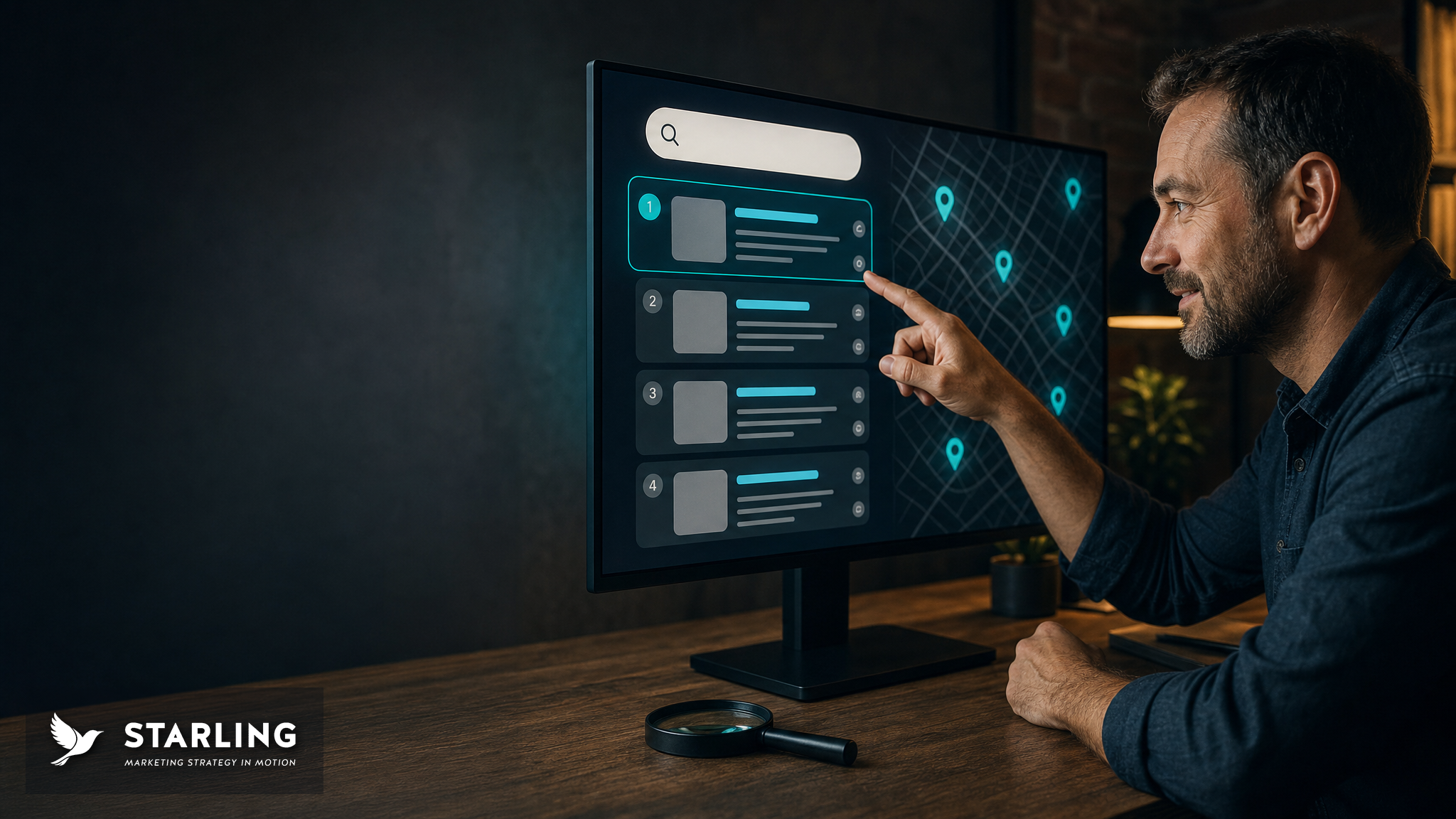
Most of what your customers buy, they buy close to home. Right now, one of them is standing in a queue or sitting in a van, thumbing a search into their phone for exactly the thing you sell. In the next ten seconds they will tap one of the results. The only question that matters is whether the name they tap is yours or the crowd down the road.
Ireland is not the US, and it is not the UK. SEO for Irish businesses means smaller search volumes, tighter geography, a directory ecosystem all of its own, Eircodes where the rest of the world has postcodes, and .ie domains that come with trust baked in. Most of the SEO advice online was written for a market ten times the size and pretends none of this exists. This guide does not.
Here is what this guide covers, written for the business owner rather than the marketer:
- Why small Irish search volumes are actually a competitive advantage
- How to set up your Google Business Profile with your Eircode and Bank Holiday hours
- Which Irish directories matter and how to list consistently
- On-page SEO fixes you can tackle in a weekend
- How AI Overviews are changing Irish search results and what to do about it
- An honest comparison of SEO vs Google Ads for Irish budgets
- Practitioner pricing guidance so you can spot overcharging
- A 90-day action plan you can start tomorrow
- What to ask an SEO agency before signing anything
Everything here uses Irish English, Irish examples, and Irish data.
Why SEO Matters More for Irish Businesses Than You Think
"Only 200 people a month search for my service in Ireland. Is SEO even worth it?"
We hear this more than any other objection. It sounds sensible. It is also exactly backwards.
Those 200 searches are 200 people with money in hand and a problem they want gone today. That is worth more than 10,000 social media impressions from people scrolling past your ad somewhere between a cat video and their cousin's holiday photos. One group is shopping. The other is killing time.
The Small-Volume Advantage
In the US or UK, ranking for "plumber" means elbowing past thousands of polished, optimised websites. In Ireland, plenty of commercial keywords have 10 to 50 pages fighting for them, and half of those barely fight at all. Less competition means faster results for the business willing to do the work properly. You can cast your line into the Atlantic alongside ten thousand other boats, or you can find the quiet lake in Roscommon where nobody else has bothered to show up. The fish are biting in both. Only one has a queue.
The Local Search Opportunity
Here is a number worth pinning above your desk. 76% of people who search for something nearby on their phone visit a related business within a day, and 28% of those searches end in a purchase. That is not idle browsing. That is someone deciding where to spend money before the kettle has boiled.
Your customers are hyper-local, and Google knows it. That is why the local pack, the little map with three business listings, sits at the top of mobile results and soaks up the clicks. If your name is not in that map, your competitor's is. There are only three slots.
The Compounding Effect
Google Ads stop the second your card stops. SEO does the opposite. It builds.
A service page that ranks today can keep pulling in work long after the day you published it. A blog post that answers a question your customers actually ask keeps earning, month after month, with nothing extra spent.
Think of it this way. A leaflet drop is gone the morning after it lands in the recycling bin, and you pay all over again for the next one. A page that answers a real customer question keeps ranking and keeps sending you work. One is a bill you keep paying. The other is an asset you build once and own for good.
Local SEO in Ireland: How to Dominate Your Area
When someone types "near me" or names their town, Google has to decide in milliseconds which businesses to put in front of them. Local SEO is how you make sure you are on that shortlist. It stands on three legs: your Google Business Profile, your local citations (directory listings), and the signals on your own website. Get one leg wrong and the whole thing wobbles.
Google Business Profile: Your Most Important Free Listing
If you do one thing this week, do this. Your Google Business Profile is the single highest-impact free SEO action available to most Irish SMBs, and it costs nothing but an afternoon. According to Google, businesses with complete profiles are 2.7 times more likely to be considered reputable, and those with photos receive 42% more requests for directions and 35% more click-throughs to their websites.
Here is how to set it up properly:
- Claim or create your profile at business.google.com. If your business already shows up on Google Maps, claim that listing. Do not create a second one, or you will end up competing against yourself.
- Use your exact business name. Resist the urge to stuff keywords in. "O'Brien Plumbing" is right. "O'Brien Plumbing Best Plumber Dublin Emergency Plumber" looks clever for about a week, then gets your listing suspended.
- Enter your Eircode. This is the one Irish businesses skip and then wonder why nobody finds them. Google uses your Eircode to drop the pin in the right spot on Maps. Wrong Eircode, wrong pin, and you vanish from the nearby searches that should have been easy wins.
- Set your service area if you travel to your customers instead of working from a shopfront. Name the towns, the counties, or the radius you actually cover.
- Add your Bank Holiday hours. St Patrick's Day, the June Bank Holiday, the August Bank Holiday, Christmas. Google rewards a complete profile, and an Irish customer will check your hours before they get in the car. Nothing loses a sale faster than someone driving to a closed door.
- Upload real photos. The inside, the outside, your team, your finished work. Not stock images of a smiling stranger who has never set foot in your premises. A fresh photo every month tells Google the lights are on and the business is alive.
- Choose specific categories. "Italian restaurant" beats "restaurant." "Emergency plumber" beats "plumber." The narrower you are, the more often you turn up for the searches that actually want you.
- Collect reviews, and reply to every single one. The large majority of consumers read online reviews to size up a local business before they ever lift the phone. A steady drip of recent reviews is one of the strongest local ranking signals there is. The good ones build trust. Replying to the bad ones, calmly, builds it even more.
Irish Citation Directories Worth Listing On
A citation is any online mention of your business name, address, and phone number. Sounds trivial. It is not. Here is where it bites: if your Google Business Profile says "12 Main St, Galway, H91 AB12" and your GoldenPages listing says "12 Main Street, Co. Galway," Google cannot tell whether that is one business or two. When Google is unsure, it stops trusting your data, and your rankings slide. Tidiness, in other words, is a ranking factor.
The directories that earn their place for Irish businesses:
- GoldenPages.ie. The grandfather of Irish directories. A free basic listing is there if you want it, though the signup nudges you hard toward the paid tiers. Worth the effort regardless, because its data feeds plenty of other directories downstream.
- YourLocal.ie. A growing Irish directory that Google indexes well. Free listing.
- Your local Chamber of Commerce website. Quietly overlooked by almost everyone, which is exactly why it works. These carry real local authority.
- Industry-specific directories. RIAI for architects, Engineers Ireland for engineers, the Law Society for solicitors. A listing here is a trust badge Google takes seriously.
The golden rule, and we mean golden: your Name, Address, and Phone number (your NAP) must read identically everywhere. "Co. Dublin" and "Dublin" are the same place to you and a different thing entirely to a database. Pick one format, add your Eircode, and use that exact wording on every listing without exception.
The .ie vs .com Decision
When Google.ie retired and started redirecting to Google.com, a fair few business owners panicked that their .ie domain had quietly lost its value. It has not. Google still reads the .ie extension as a local relevance signal, alongside your IP address and the content on your pages.
A .ie domain carries a trust advantage you will not find anywhere else. To register one, you have to prove a genuine connection to Ireland, which keeps out the cybersquatters and the fly-by-night operators. Irish customers know this in their bones. To them, .ie quietly says "this is one of ours."
The decision is not complicated:
- Serving Ireland only? .ie is the stronger trust signal. Take it.
- Serving Ireland and markets abroad? A .com can work, as long as you load it with Irish signals: your address, your Eircode, Irish English throughout.
- Already sitting on an established .com with real authority? Leave it alone. Add the Irish signals instead. The authority you have already built outweighs the letters after the dot.
On-Page SEO Basics Every Irish Business Should Get Right
On-page SEO is everything you control on your own website to help Google work out what a page is about and whether it has earned a spot. It is the part of search engine optimisation Ireland's small business owners can genuinely do themselves without a specialist. The good news for anyone dreading a technical rabbit hole: most of these are honest, hands-on fixes you can knock out over a wet weekend with the football on in the background.
The Essential Checklist
- Location pages with real local detail. Serve a few towns, say Dublin, Galway and Limerick? Build a proper page for each one, written from scratch, with the local Eircode routing areas you cover. The cardinal sin here is copying one page and swapping the town name, and Google spots it instantly. Write about the local landmarks, the jobs you actually do in that area, and how to find you. A page titled "Plumbing in Galway" should read like the person who wrote it has fixed a tap in Salthill.
- Title tags with your location. Every page needs its own descriptive title that names where you work: "Plumbing Services in Cork | O'Brien Plumbing." Keep it under 60 characters or Google trims it mid-word.
- One clear H1 per page. Your homepage H1 should never be "Welcome." Welcome tells a searcher nothing and tells Google less. Make it earn its keep: "Emergency Plumbing Services in Cork City."
- Write in Irish English. "Colour," "centre," "specialised." Google can read the language of your content, and an Irish reader clocks American spelling as faintly off even when they cannot put a finger on why. More on this in a moment.
- Content that answers the real question. Someone types "how much does a kitchen renovation cost in Ireland" because they want a number, not a brochure. Give them the answer. The pages that satisfy the search are the pages that win the search.
- Image alt text and internal links. Describe your images like a human would ("Modern kitchen renovation in a Galway home," not "IMG_3847"), and link your related pages to one another so Google can map your site and pass authority around it. Every internal link is a quiet vote for the page it points to.
Core Web Vitals: Check Your Own Site
Google measures how fast and how smoothly your website feels to use, and it has a clear line in the sand: your site should load in under 3 seconds on a phone. Cross that line and people leave. As page load time climbs from 1 to 10 seconds, the probability of a visitor bouncing rises by 123%. Picture a Limerick customer waiting on a wheel that just keeps spinning. They are not waiting. They are already back on Google, tapping the next result, which belongs to your competitor.
Check yours for free: drop your URL into Google PageSpeed Insights. Look at the mobile score and whether you clear that 3-second mark. If you do not, have a word with your web development team before you spend a cent on anything else.
The Irish English Note
If your customers are Irish, write the way they read. "Colour" not "color." "Centre" not "center." "Specialised" not "specialized." It is a small thing that does two jobs at once: it tells Google the language of your content, and it tells your reader you are one of them. A site written in American English feels subtly foreign to an Irish audience, even when nobody can quite say why. Why hand a stranger that small advantage?
AI Overviews and the Changing Face of Irish Search Results
You have seen it by now: that block of AI-written answer sitting at the very top of Google, above everything you used to fight to rank for. For "what is" and "how to" questions, it often answers the searcher so completely that they never scroll, never click, and never land on anyone's website at all. For a lot of businesses, that is a quiet alarm bell.
It is worth taking seriously. A September 2025 Seer Interactive study found that organic click-through rates for informational queries featuring AI Overviews fell 61%, and paid click-through rates on those same queries dropped 68%. Read that again. Businesses sitting in the top three spots on Google, the positions everyone covets, are pulling fewer visitors than they were a year ago for the same rank.
What This Means for Irish Businesses
The damage is not spread evenly, and that matters. Informational content takes the heaviest hit: blog posts, guides, "how to" articles, the stuff an AI can summarise in a sentence. Commercial and local searches come off far lighter. When someone types "electrician near me" or "best restaurant Galway," Google still serves the local pack, the business listings, and the product results, because those are buying decisions and an AI summary cannot make the booking for you.
So the business most exposed is the one living on generic informational blog traffic with nothing commercial behind it. If that sounds uncomfortably familiar, keep reading.
How to Adapt
Chase commercial intent. "Emergency plumber Cork" earns its keep in a way "what does a plumber do" never will. Point your service pages at people who are ready to hire, not people idly curious.
Make the thing an AI cannot. Original case studies with real Irish figures. The opinion you have earned from years on the tools. Local detail no summary engine can invent because it has never driven the road. Google's E-E-A-T framework (Experience, Expertise, Authoritativeness, Trustworthiness) was built to reward exactly this, and it is your moat.
Become the name people search for. When a customer types your business name straight into Google, the AI Overview is beside the point. So build the name. Get on the podcast, into the local paper, onto the industry sites. Even a mention with no link attached strengthens your authority in Google's eyes.
The Silver Lining
Here is the part the doom-mongers leave out. AI Overviews are rolling out unevenly across markets, and Ireland, being smaller, is further down the queue. Plenty of Irish searches do not trigger an AI Overview at all yet. Local and commercial results are largely untouched. And every business that gives up on real, expert content because "AI killed SEO" is one fewer rival standing between you and the top. The field is not getting more crowded. For the people doing it properly, it is getting emptier.
SEO vs Google Ads: Which Should Your Irish Business Choose?
It depends. We know that is the answer nobody wants, but anyone who gives you a clean one-word reply before they have asked about your business is selling, not advising.
Both channels earn their place. Which one earns more of your money comes down to three things: how fast you need results, what you can spend, and how your business actually makes money.
When Google Ads Makes More Sense
- You need leads this week. A brand-new business, a seasonal surge, a one-off event: none of them can wait six months for organic rankings to ripen.
- You are testing the water. Trying a new service or a new town before you commit to a year of content? Ads tell you fast whether the demand is real.
- Your competitors already own the organic results. While you build your way up, ads keep you visible instead of invisible.
- One sale is worth a fortune. If a single lead is worth thousands of euro, the cost per click is a rounding error and you should be bidding aggressively.
When SEO Makes More Sense
- You want traffic that does not switch off with your card. Compounding, durable, yours.
- You serve a local patch and can realistically own the map pack. Three slots, your name in one of them, for months.
- Your industry runs on research. When people read before they buy, you can be the source they decide to trust.
- You are building something to last. A brand, not a burst.
The "Both" Approach
In practice, most Irish businesses we work with do not pick a side. They run Google Ads for leads today while building SEO for leads next year. Then, as the organic rankings climb, they quietly dial back ad spend on the keywords they now own for free. The cleanest way to think about it: ads are rent, SEO is the mortgage. One keeps a roof over your head this month. The other builds something you eventually own outright.
Real Cost Comparison
Google Ads. You pay per click, every click, forever. In competitive Irish sectors the cost per click runs into the high single digits, and legal or financial keywords climb higher again. A steady flow of leads might run from a few hundred to a couple of thousand euro a month in ad spend, plus the management fee on top. The catch is the same as the appeal: the day you stop paying is the day the leads stop arriving.
SEO. Monthly retainers swing widely with scope and competition (the pricing guide below breaks it down). Results take 3 to 6 months to show, and then they keep showing, long after the work that earned them. Leads that come in through SEO are usually far cheaper to win than leads chased down through outbound, for one simple reason: the customer came looking for you.
The LEO angle. Worth knowing about. Local Enterprise Offices run the Grow Digital Voucher, worth up to 5,000 euro at 50% match funding, to help small businesses with digital projects. Eligible costs cover things like software and training. Whether SEO services qualify varies from office to office, so check with your local LEO before you bank on it.
What Does SEO Cost in Ireland? Real Pricing and What You Get
Most agencies guard their pricing like a state secret, which is precisely how a business owner ends up overpaying without ever knowing it. The cost of SEO Ireland-wide is more predictable than that secrecy suggests, once you know what to look for. So here are the real ballpark figures, the ones that let you walk into a sales call and tell a fair quote from a rip-off. A fair warning before the numbers: these are practitioner estimates, drawn from what Irish agencies actually charge rather than a published survey, so treat them as a guide and not gospel.
Irish SEO Pricing Tiers (2026)
| Tier | Monthly Cost | What's Typically Included | Best For |
|---|---|---|---|
| Basic | 400-800 euro/month | Google Business Profile optimisation, basic on-page fixes, monthly reporting | Solo traders, single-location businesses |
| Mid-range | 800-2,500 euro/month | Content creation, link building, technical SEO, local citations, ongoing optimisation | Growing SMBs, multi-service businesses |
| Comprehensive | 2,500-6,000+ euro/month | Full strategy, content marketing, digital PR, conversion optimisation, detailed analytics | Competitive sectors, multi-location, ecommerce |
Dublin commands the highest prices, plainly because the competition is fiercer. The same scope of work that costs one figure in Waterford will cost a small business more in the capital, simply because there are more rivals to climb over. Hourly consulting rates from Irish SEO professionals land at roughly 75 to 150 euro, and that too is a guide rather than a fixed rate card.
What Affects the Price
- How crowded your sector is. A Dublin solicitor is wading through hundreds of rivals. A farrier in Roscommon has the field almost to himself. One of those takes far more work to win.
- The state your website is in. A clean, modern WordPress site needs a very different job to a static site built back in 2012 and never touched since.
- How wide you want to cast. One town, all of Leinster, or the whole country. Each step up multiplies the workload, and the bill follows.
- How much content you need. Some businesses want four blog posts a month. Others just need the technical plumbing fixed and left alone.
Red Flags on Pricing
- Anyone who guarantees page 1. Nobody controls Google's algorithm, so nobody can promise a spot on it. A legitimate agency knows this and says so.
- Lock-in contracts past 6 months with no performance clauses. A good agency keeps you because the work is working, not because the contract has you cornered.
- No clear reporting on what they actually do each month. If you cannot see the work, the honest question is whether it is being done at all.
- Prices well below 400 euro a month. The job cannot be done properly at that price, full stop. At that number you are buying a monthly report, not results, and the two are not the same thing.
The LEO Grant Angle
There is money on the table here, and most owners never claim it. The old Trading Online Voucher closed to applications on 31 October 2024. Its replacement, the Grow Digital Voucher, is worth up to 5,000 euro at 50% match funding, open to businesses with 1 to 50 employees that have been trading at least six months. One condition trips people up every time: before you can apply, you need to have completed a "Digital for Business" project, a consultation with your Local Enterprise Office, within the previous two years.
The voucher covers eligible costs like software subscriptions and training or IT configuration. It does not broadly stretch to agency fees or ad spend, and whether SEO services qualify shifts from one LEO to the next. So the move is simple and worth making: book the Digital for Business consultation, then ask your local office, in plain terms, whether your planned SEO work is eligible before you commit a cent.
Getting Started: A 90-Day SEO Action Plan for Irish Businesses
Nobody does all of this in a weekend, and trying to is how owners burn out and give up by Wednesday. So here is the plan broken into twelve manageable weeks. It works whether you are rolling up your sleeves yourself or handing a clear brief to an agency.
Month 1: Foundations (Weeks 1-4)
Week 1. Claim and fully complete your Google Business Profile. Eircode in, photos up, Bank Holiday hours set, every service listed, the most specific categories chosen. This is the single highest-return hour of the whole quarter. Start here.
Week 2. Run your website through Google PageSpeed Insights and write down anything scoring below 50 on mobile. If your site takes more than 3 seconds to load on a phone, flag it to your web developer before you spend on anything else. A slow site quietly leaks the very customers the rest of this work is dragging in.
Week 3. List your business on GoldenPages.ie, YourLocal.ie, and your local Chamber of Commerce site. Then the part everyone rushes and regrets: make sure your name, address, phone number, and Eircode read word-for-word the same on every one.
Week 4. Set up Google Search Console, which is free, and connect it to your site. From now on you can see the exact words people type to find you, how often you turn up, and how many of them click. This is the closest thing to reading your customers' minds you will ever get for nothing.
Month 2: On-Page Optimisation (Weeks 5-8)
Weeks 5-6. Audit your top 5 service pages, one honest look each. Does it have a clear title tag with your location? An H1 that says what the page is actually about? A meta description that reads like a tiny advert rather than an afterthought? Fix whatever is missing.
Week 7. Write one genuinely useful piece of content. Take the question your customers ask you most often, the one you answer on the phone three times a week, and answer it properly in 800 words or more. Pour in the expertise and the real numbers only you have.
Week 8. Wire your pages together. Add internal links between your service pages and any blog content, and point your homepage at the service pages that matter most. You are building roads for both Google and your customers to travel.
Month 3: Reviews and Content (Weeks 9-12)
Weeks 9-10. Build a review habit, not a one-off scramble. After every job or sale, send a short follow-up email with a direct link to your Google review page. One click, no faffing about. Aim for two to three fresh reviews a month and the momentum looks after itself.
Weeks 11-12. Write a second piece of content answering another common customer question, and link it to the relevant service pages. You are now stacking what is called topical authority, the strongest on-page ranking factor according to a study of 250,000+ search results. Two pieces in, you are already ahead of most of your competitors, who wrote none.
What to Measure After 90 Days
- Google Search Console. Are your impressions climbing? Rising impressions mean Google has started noticing your pages, and that always shows up before the clicks do.
- Google Business Profile Insights. How many people viewed your profile, asked for directions, or rang you straight from it?
- Rankings. Check your target keywords in an incognito window. Moving from page 5 to page 2 is not a small thing, it is real progress. SEO compounds, and these first 90 days are the foundation the rest is built on. Do not judge the harvest by the first sprout.
How to Choose an SEO Agency in Ireland: Questions to Ask
Handing an agency a monthly retainer is a real bet on a real budget, and the industry has more than its share of chancers happy to take it. These seven questions are the ones that flush them out. Ask them all, and watch how the answers change in the room.
Questions to Ask Before Signing
- "Can you show me Irish case studies from the last 18 months?" Ask for recent, named results from businesses like yours, with numbers you can actually check: traffic up, leads up, rankings won for keywords you can search yourself. Dusty old wins or nothing but international examples should give you pause. The Irish market behaves differently, and you want proof they have won in this one, not somewhere else.
- "What will you actually do each month?" You want a clear scope of work: the content pieces, the technical audits, the link building, the reports you will receive. "We'll optimise your site," with no detail behind it, is the sound of someone hoping you will not ask twice.
- "How do you report on progress?" A good answer is a monthly report showing rankings, traffic, conversions, and the work that was done. A bad one is no report at all, or a report stuffed with vanity metrics like "domain authority improved by 2 points," a number that looks impressive and pays no bills.
- "What's your approach to Irish link building?" You are listening for real Irish authority: coverage in Irish media, listings with Chambers Ireland, ISME, or your industry body, genuine partnerships with Irish organisations. Be wary of "we have a network of sites." That phrase usually means private blog networks, and those can get your site penalised rather than promoted. A handful of links from relevant Irish sources beats a thousand from nowhere.
- "Do you guarantee rankings?" There is only one right answer, and it is no. Google weighs hundreds of factors and changes its mind constantly. Anyone promising you a specific spot is either lying to your face or using tactics that put your site at risk. Either way, walk.
- "What happens if I want to leave?" A good answer is a 30 to 60 day notice period and you keep everything done on your site. A bad one is a 12-month lock-in where the agency quietly keeps ownership of your content or your backlinks, and takes them with them on the way out.
- "Who will actually work on my account?" You want to meet the person doing the work, not just the smooth operator who closed the sale. If the honest answer is "it all gets outsourced overseas with nobody watching," you have your answer about how much your account will matter once the ink dries.
Red Flags Summary
- Guaranteeing page 1 rankings
- No Irish case studies or references
- Unwilling to explain their methods
- Prices below 400 euro per month
- No clear contract or scope of work
- Long lock-in periods with no exit clause
If you would like to talk through your SEO options with an Irish agency that is happy to answer all of the above, Starling Digital offers a free initial consultation.
Frequently Asked Questions
How long does SEO take to work in Ireland?
Usually 3 to 6 months before the rankings move in a way you can feel. Quieter niches and rural areas can come good faster. Dublin and the hard-fought sectors, legal and financial in particular, can take 6 to 12 months. If you need leads this week and not next quarter, run Google Ads alongside SEO while the organic side builds underneath you.
Is SEO worth it for a small business with a tiny budget?
Yes, as long as you aim it. A fully optimised Google Business Profile, 3 to 4 strong service pages, and a steady review habit will beat a scattered big-budget campaign that tries to do everything and lands nothing. The visibility you build keeps paying out long after the spend stops, so a small, focused budget spent well goes a long way.
Should I use a .ie or .com domain?
Serving Ireland and nowhere else? .ie builds trust and tells Google exactly where you belong. Eyeing markets abroad? A .com loaded with strong Irish content signals does the job too. The one rule that overrides both: never switch an established domain. The authority you have already earned matters far more than the letters at the end.
Can I do SEO myself or do I need an agency?
You can absolutely handle the basics yourself: the Google Business Profile, on-page tidying, writing your content, gathering reviews. Where an agency earns its fee is the deeper work, technical audits, strategic link building, competitor analysis, and keeping pace with Google's constant algorithm changes. The 90-day plan above was written so a business owner can run it without anyone's help.
What's the difference between SEO and local SEO?
SEO is the whole craft of ranking in search engines. Local SEO is the part of it aimed at geography: getting into the map pack, winning "plumber Cork" or "restaurant near me." For most Irish SMBs serving a defined area, local SEO brings the most qualified traffic against the least competition, which is why it is usually where the money is best spent first.
Will AI replace SEO?
AI is changing how the results look, not whether people search. They still do, and your business still needs to be found when they do. Gartner forecasts that up to 25% of traditional organic traffic could shift to AI platforms by 2026, so the move is clear: create content that shows real expertise, build your brand so people search your name directly, and lean into the commercial queries where AI summaries hold least sway.
Need help getting your Irish business ranking? Starling Digital specialises in SEO for Irish businesses, from local trades to national brands. Get in touch for a free consultation.
Ready to get found on Google?
We help Irish businesses climb the rankings and turn local searches into paying customers.
See SEO Services Or book a free consultation first.